

What Is Industrial Design and Why Does Your Product Need It in 2026?
What is Industrial Design?
Industrial design is the discipline that determines how a physical product looks, feels, and works. It covers form, materials, ergonomics, user interaction, and visual identity — but in professional practice, it’s never separate from the engineering and manufacturing decisions that determine whether the product can actually be made.
Table of Contents
That distinction matters. A product that’s been industrially designed without manufacturing consideration is a concept. A product where the industrial design and the engineering have been developed together is something that can go to production. At Bluefrog Design, based in Leicestershire, we’ve been doing both for over twenty years across consumer, industrial, and medical sectors.
This article explains what industrial design actually involves, how it connects to engineering and manufacture, and why it matters for anyone developing a physical product.
What industrial design covers
Industrial design defines the physical characteristics of a product: its shape, proportions, surface treatment, colour, material expression, and how it communicates its function to the user. But it goes well beyond appearance.
A well-executed industrial design determines how the product feels in the hand, how intuitive the controls are, how the user understands what the product does without reading a manual, and how the product’s visual language positions it in its market. It also accounts for the environment the product will be used in — whether that’s a kitchen counter, a factory floor, a hospital ward, or an outdoor site.
In practical terms, industrial design involves concept generation (exploring multiple design directions), design development (refining the chosen direction into a detailed proposition), user-centred decision making (understanding how real people will interact with the product), material and finish specification (choosing materials that work aesthetically, functionally, and commercially), and the development of a consistent design language that can extend across a product range.
Why industrial design can’t be separated from engineering
This is where many product development projects go wrong. Industrial design and engineering are treated as sequential activities: a designer creates the form, then an engineer works out how to make it. The result is usually a product that either needs significant redesign to be manufacturable, or one where the engineering constraints override the design intent and the final product looks compromised.
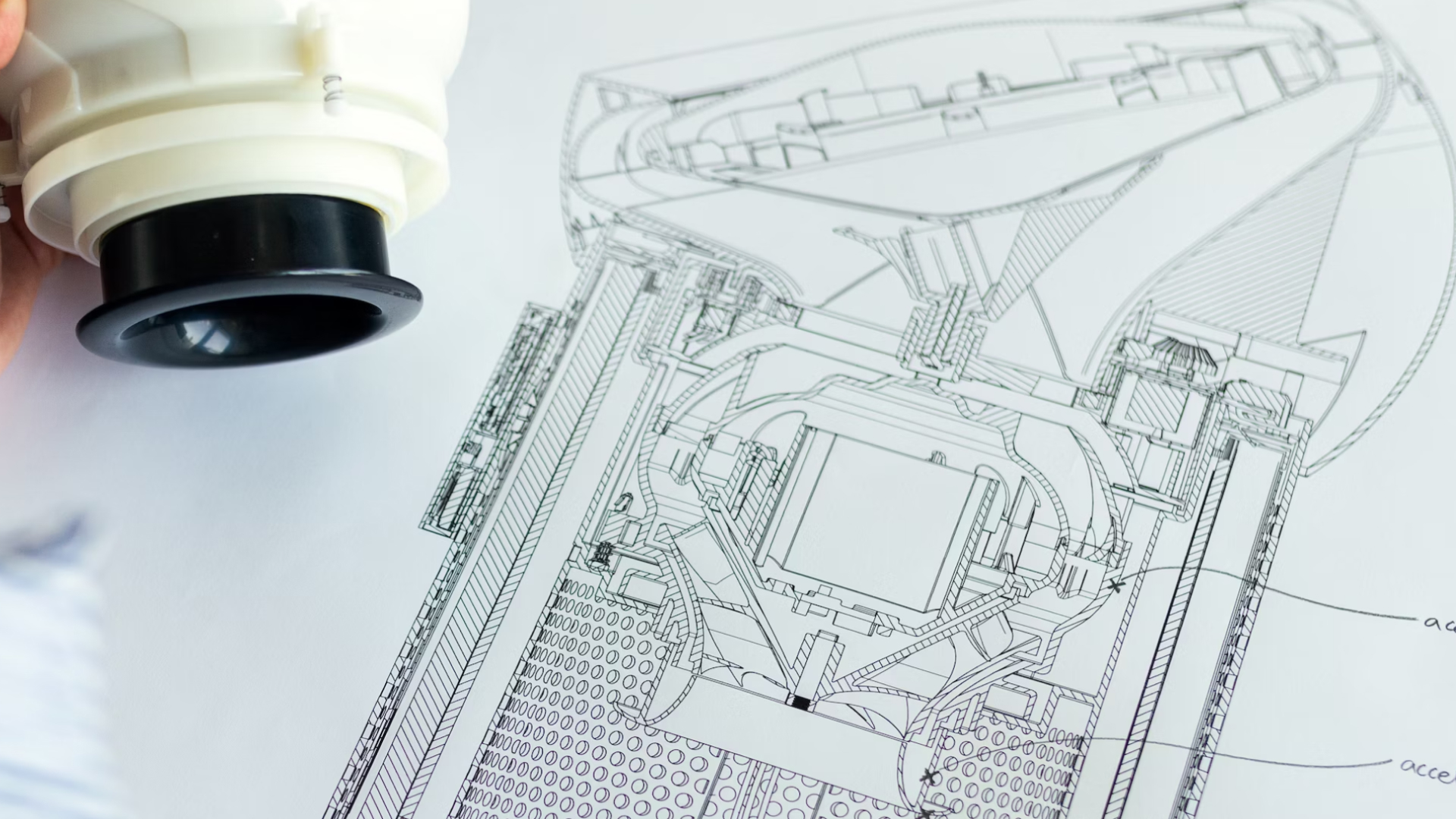
The better approach — and the one that produces better products — is to integrate industrial design and engineering from the start. The choice of manufacturing process shapes what forms are achievable. Material selection affects both appearance and structural performance. Assembly method determines where split lines, fixings, and access points fall. These are not problems to solve after the design is finished — they’re parameters that should inform the design from day one. This integrated approach is the foundation of effective design for manufacture.
When industrial design and engineering are developed together, the product looks the way it does because of the engineering logic, not in spite of it. The design language emerges from the construction, and the result is a product that feels considered and well-made rather than decorated.
What industrial design means for manufacturing
Every industrial design decision has a manufacturing consequence. A curved surface that looks elegant may require expensive tooling. A flush joint that looks premium may demand tolerances that are difficult to achieve in production. A material that photographs well may not survive the environment the product will be used in.
An industrial designer who understands manufacturing makes these trade-offs consciously, not accidentally. They know that sheet metal fabrication creates a different visual language to injection moulding. They understand that a textured surface hides sink marks on moulded parts. They recognise that a certain radius is achievable on a press brake but not on a bending machine. This knowledge doesn’t limit the design — it makes the design more intelligent.
The products that manufacture well and look good are the ones where the industrial designer understood the production process from the start. The products that cause problems are the ones where the industrial design was developed in isolation and handed over as a styling exercise. A complete manufacturing data pack should reflect both the design intent and the manufacturing reality.
How industrial design works across different sectors
The principles of industrial design are consistent, but the application varies significantly by sector:
Consumer products
Appearance and perceived quality drive purchasing decisions. The product needs to communicate its value from the shelf or the screen. Material feel, surface finish, colour, and packaging all contribute. At the same time, the design needs to hit a cost target that works within retail price points, which means the industrial design must be developed alongside the manufacturing strategy.
Industrial products
Durability, usability in demanding environments, and serviceability are primary concerns. Operators may be wearing gloves. The product may need to withstand impact, chemicals, or temperature variation. The industrial design needs to communicate robustness and reliability while making controls intuitive and maintenance straightforward. Appearance matters, but it’s in service of function and trust rather than shelf appeal.
Medical devices
Regulatory requirements directly affect the design. Materials must meet biocompatibility standards. Surfaces must be cleanable to clinical standards. Controls must be operable by clinicians under time pressure. The industrial design must work within the constraints of ISO 13485 and other applicable standards while creating a product that communicates precision and reliability to its users.
The role of prototyping in industrial design
Industrial design cannot be fully evaluated on screen. CAD renders and visualisations are useful for reviewing proportions, colour, and general form, but they don’t tell you how a product feels in the hand, whether the controls are comfortable to operate, or whether the visual presence works at actual scale. Prototyping bridges this gap.
Visual models — physical representations of the design at full scale, often in the correct colour and finish — allow the design to be evaluated in three dimensions. They reveal proportions that looked correct on screen but feel wrong in reality. They show how light falls on surfaces, how materials interact at joints, and how the product sits in its intended environment.
Functional prototypes go further, integrating working mechanisms, electronics, and user interfaces to test how the product performs in use. These are not just engineering validation tools — they’re industrial design tools, because the way a product works is inseparable from the way it’s designed.
Design language and product ranges
One of the most valuable outcomes of good industrial design is a coherent design language — a set of visual cues, proportions, material choices, and form characteristics that make a range of products look like they belong together. This is what gives a product range brand identity.
Developing a design language is not just about visual consistency. It’s also an engineering and manufacturing efficiency tool. When products in a range share the same design principles, they often share components, manufacturing processes, and assembly methods. A product family built on a common platform — shared chassis, common fixings, interchangeable sub-assemblies — costs less to manufacture and is easier to maintain than a family of products that were each designed independently.
The design language established for one product can be extended across an entire range, creating a cohesive brand presence while reducing manufacturing complexity. This is something Bluefrog Design has delivered on multiple projects — where the industrial design work on a lead product set the visual direction for the client’s full product portfolio.
What to look for in an industrial design consultancy
One of the most valuable outcomes of good industrial design is a coherent design language — a set of visual cues, proportions, material choices, and form characteristics that make a range of products look like they belong together. This is what gives a product range brand identity.
Developing a design language is not just about visual consistency. It’s also an engineering and manufacturing efficiency tool. When products in a range share the same design principles, they often share components, manufacturing processes, and assembly methods. A product family built on a common platform — shared chassis, common fixings, interchangeable sub-assemblies — costs less to manufacture and is easier to maintain than a family of products that were each designed independently.
The design language established for one product can be extended across an entire range, creating a cohesive brand presence while reducing manufacturing complexity. This is something Bluefrog Design has delivered on multiple projects — where the industrial design work on a lead product set the visual direction for the client’s full product portfolio.
At Bluefrog Design, industrial design and engineering are integrated from the first concept. We’re a small, experienced team based in Leicestershire, and we’ve been taking products from idea through to complete manufacturing data for over twenty years across consumer, industrial, and medical sectors. If you’re developing a product and want the industrial design and engineering to work as one, get in touch.
View more of our Product Development Services
If you would like to hear more on how we can improve the quality of your products or help with your product development, please contact Bluefrog Design at mail@bluefrogdesign.co.uk
FAQ’s
What is industrial design?
Industrial design is the professional discipline that determines the physical form, appearance, materials, ergonomics, and user interaction of manufactured products. It covers everything from the shape and proportions of a product to how it communicates its function, how it feels in the hand, and how its visual language positions it in its market. In professional practice, industrial design works alongside engineering and manufacturing considerations to produce products that can be produced at cost and at scale.
What is the difference between industrial design and product design?
The terms are often used interchangeably. In practice, industrial design tends to refer specifically to the form, aesthetics, and user interaction aspects of a product, while product design can encompass the full development process including engineering, prototyping, and design for manufacture. Many consultancies, including Bluefrog Design, offer both as an integrated service.
Why is industrial design important for manufacturing?
Every industrial design decision has a manufacturing consequence. Material choice, surface finish, geometry, and assembly method all affect what manufacturing processes are required, what tooling is needed, and what the unit cost will be. Industrial design that is developed without manufacturing awareness often results in products that are expensive to produce, difficult to assemble, or require significant redesign before production. Industrial design that is integrated with engineering from the start produces products that are both well-designed and manufacturable.
Does Bluefrog Design offer industrial design services?
Yes. Bluefrog Design, based in Leicestershire, integrates industrial design with engineering and design for manufacture on every project. The team takes products from initial concept through to complete manufacturing data across consumer, industrial, and medical sectors, and has been operating since 2003.
Ready to get started on a project?

Socials


