

What Does a Manufacturing Data Pack Actually Include?
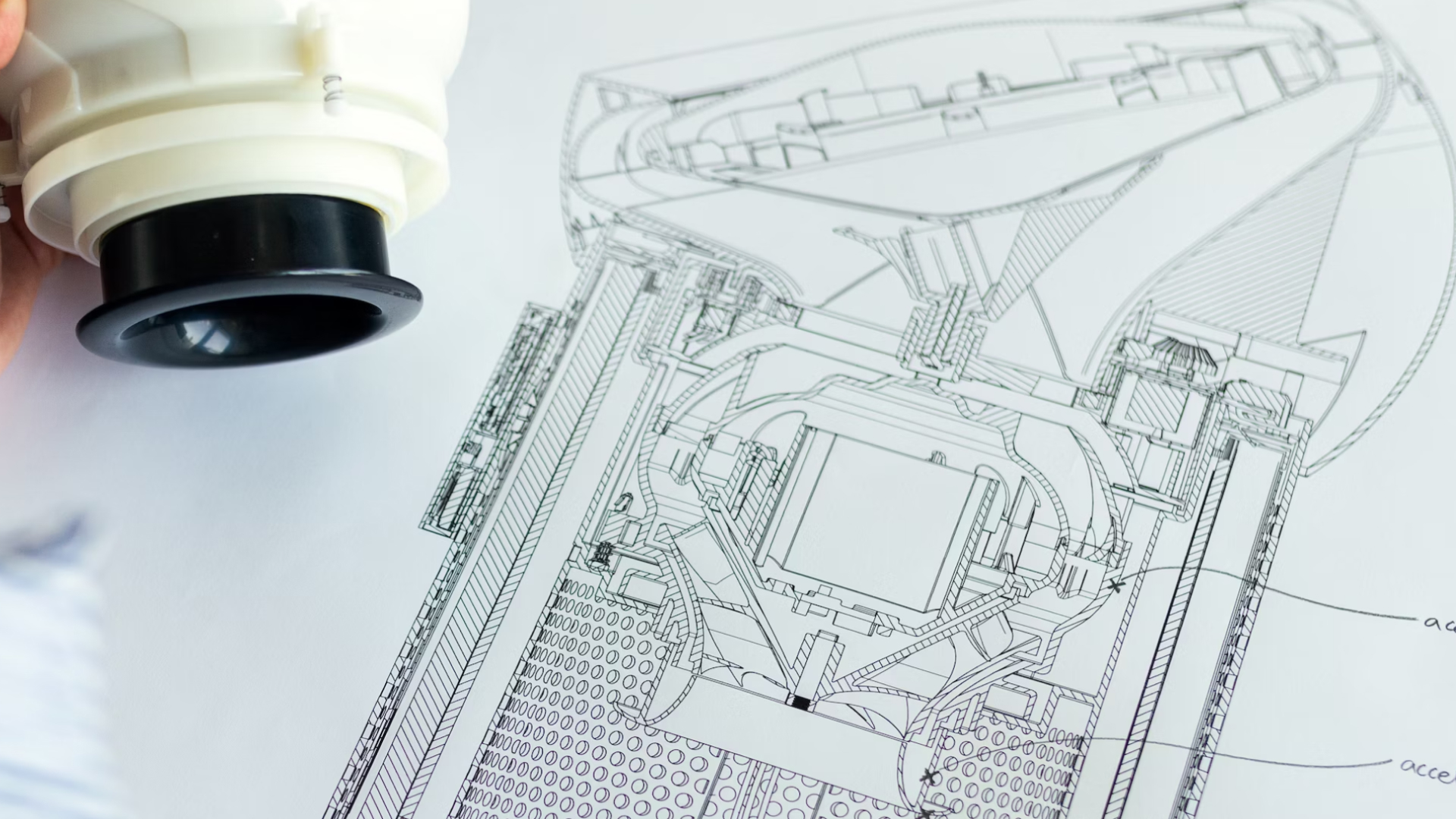
If you’ve been working with a product design consultancy or you’re about to you’ve probably heard the term “manufacturing data pack.” It’s the main deliverable at the end of most product development projects: the document set that gets your product from finished design to manufactured product.
Table of Contents
But what’s actually in it? What does each element do? And why does your manufacturer need all of it?
At Bluefrog Design, based in Leicestershire, a manufacturing data pack is what we deliver at the end of every project that goes through to production. We’ve been doing this for over twenty years across consumer, industrial, and medical sectors, so we know what manufacturers need to receive in order to quote accurately, produce consistently, and deliver parts that meet specification. This article breaks it down.
Why it matters
A 3D CAD model on its own is not enough to manufacture from. It shows geometry, but it doesn’t tell the manufacturer which dimensions are critical, what tolerances are acceptable, what material to use, what surface finish to apply, or how the parts go together. Without this information, the manufacturer is making assumptions and these assumptions in manufacturing lead to rejected parts, delays, and cost overruns.
A complete manufacturing data pack removes ambiguity. It gives the manufacturer everything they need to produce the product without having to interpret design intent or make decisions that should have been made during design. It’s also what allows you to get accurate quotes from multiple suppliers, because every manufacturer is quoting against the same specification.
A 3D CAD model on its own is not enough to manufacture from. It shows geometry, but it doesn’t tell the manufacturer which dimensions are critical, what tolerances are acceptable, what material to use, what surface finish to apply, or how the parts go together. Without this information, the manufacturer is making assumptions and these assumptions in manufacturing lead to rejected parts, delays, and cost overruns.
A complete manufacturing data pack removes ambiguity. It gives the manufacturer everything they need to produce the product without having to interpret design intent or make decisions that should have been made during design. It’s also what allows you to get accurate quotes from multiple suppliers, because every manufacturer is quoting against the same specification.
What’s in a manufacturing data pack
The exact contents vary depending on the complexity of the product, the manufacturing process, and the sector. But a typical manufacturing data pack from a product design consultancy includes the following:
What’s in a manufacturing data pack
The complete 3D model of every component and the full assembly, provided in both native format and a transferable format such as STEP or IGES. The native files allow future modifications if needed. The STEP files ensure any manufacturer can open and work with the geometry regardless of what CAD system they use.
The 3D data defines the form of every part but on its own, it’s a starting point, not a manufacturing instruction.
2D production drawings
These are the documents a manufacturer actually works from on the production floor. Every manufactured and engineered component gets its own fully dimensioned 2D drawing showing all critical dimensions, tolerances, material specification, surface finish, and any special requirements such as thread callouts, weld specifications, or surface treatments.
The 2D drawing is where design intent becomes manufacturing instruction. It tells the manufacturer not just what shape to make, but how accurately it needs to be made, from what material, and to what finish. Without these, the manufacturer has to measure from the 3D model and guess at what’s important which is where errors start.
For a typical product, this might mean 15 to 40 individual drawings depending on part count. Every manufactured part gets its own drawing. Bought-in components like screws, bearings, and electronics are referenced on the BOM but don’t need individual drawings.
Bill of materials (BOM)
The BOM is the complete list of everything in the product: every manufactured part, every bought-in component, every fastener, every seal, every label. Each item has a part number, description, material, quantity per assembly, and supplier or specification reference where applicable.
This is what the manufacturer uses to source components and plan production. It’s also what your purchasing team uses to cost the product, manage inventory, and identify supply chain dependencies. A well-structured BOM makes the difference between a production process that runs smoothly and one that stalls because someone didn’t know they needed forty M4 stainless steel cap heads until the assembly line was waiting for them.
Assembly drawings and instructions
These show how the individual parts come together to form the finished product. A good assembly drawing includes an exploded view showing the relationship between components, a step-by-step assembly sequence, callouts for fasteners and fixings with torque specifications where relevant, and notes on any critical assembly requirements such as adhesive cure times, alignment procedures, or quality checks at specific stages.
For simpler products, a single assembly drawing may be sufficient. For more complex products with sub-assemblies, each sub-assembly gets its own drawing and the top-level drawing shows how the sub-assemblies come together. The goal is that someone on the production line can follow the instructions and build the product correctly, consistently, and efficiently without needing to consult the designer.
Material and finish specifications
Every part in the product needs a defined material — not just the generic type, but the specific grade. There’s a significant difference between “stainless steel” and “316L stainless steel” in terms of corrosion resistance, machinability, and cost. The same applies to plastics: “ABS” is not a specification; “ABS Novodur P2MC Natural” is.
Surface finishes need the same level of specificity. Powder coat, anodise, chromate conversion, paint, polished, bead-blasted, textured — each has different cost, durability, and appearance characteristics. The data pack should specify the finish for every visible surface, including colour references (typically RAL or Pantone), gloss levels, and any masking requirements for areas that must remain unfinished for assembly or functional reasons.
Tolerance callouts
Tolerances define how much variation from the nominal dimension is acceptable. They’re specified on the 2D drawings, but they deserve a specific mention because they’re one of the most consequential elements in the data pack.
Tolerances that are too tight increase manufacturing cost and rejection rates, every part that falls outside tolerance is scrapped or reworked. Tolerances that are too loose cause fit and function problems during assembly. The skill is in specifying tolerances that are appropriate for the manufacturing process and the function of each interface: tight where it matters for fit, function, or appearance, and relaxed where it doesn’t.
A well-toleranced data pack also distinguishes between critical dimensions and general dimensions. Critical dimensions get specific callouts. General dimensions are covered by a general tolerance note that applies to everything else. This saves the manufacturer from having to treat every dimension as critical, which keeps cost down without compromising quality where it counts.
What else might be included
Depending on the product and the sector, a manufacturing data pack may also include:
- Supplier recommendations for key components and manufacturing processes, based on the design team’s experience and existing relationships
- Quality inspection criteria defining what to check, how to check it, and what the acceptance limits are — particularly important for safety-critical or regulated products
- Packaging specifications covering how the product should be packed for shipping, including any protective requirements for sensitive components
- Compliance documentation such as material declarations, RoHS compliance certificates, or references to relevant standards (UKCA, CE, ISO 13485, EN 60601) that the product must meet
- Test specifications defining any functional or performance tests that must be carried out during or after production
For medical devices and safety-critical industrial equipment, the documentation requirements are typically more extensive, reflecting the regulatory standards that apply in those sectors.
What a manufacturer does with it
A complete manufacturing data pack allows the manufacturer to do several things that aren’t possible without it:
- Quote accurately — because every material, process, tolerance, and finish is specified, there’s no guesswork in the costing. This also means quotes from different manufacturers are directly comparable.
- Plan production — the BOM and assembly instructions tell them what to order, what to make, and in what sequence. Lead times can be established for every component.
- Produce consistently — with dimensioned drawings and tolerance callouts, the manufacturer knows exactly what to make and what the acceptance criteria are. Part-to-part variation stays within controlled limits.
- Inspect and quality-check — the drawings and specifications define what “good” looks like, so incoming parts and finished assemblies can be checked against a clear standard.
- Resolve issues independently — when a manufacturing question arises, the data pack provides the answer. The manufacturer doesn’t need to come back to the designer for every decision, which keeps production moving.
What happens without one
Products that go to manufacture without a complete data pack tend to experience the same problems. The manufacturer receives a 3D model and has to guess at materials, tolerances, and finishes. They quote conservatively because the specification is unclear, making the unit cost higher than it needs to be. First-off parts don’t fit together properly because nobody specified which interfaces were critical. Assembly takes longer than expected because there are no instructions and the build sequence isn’t obvious. Issues get referred back to the designer repeatedly, slowing production and adding cost.
In the worst cases, tooling is commissioned against incomplete data and then needs modifying once the missing specifications are finalised an expensive and entirely avoidable situation.
The data pack is the bridge between design and production. Without it, the manufacturer is building from incomplete information, and the product pays the price in cost, quality, and time.
What to expect from a design consultancy
If you’re hiring a product design consultancy to develop your product, the manufacturing data pack should be a clearly defined deliverable. Before the project starts, you should understand what will be included, in what format, and at what stage it will be delivered.
At Bluefrog Design, the manufacturing data pack is the standard output of any project that goes through to the production-ready stage. It includes everything described in this article: 3D CAD data in native and STEP format, fully dimensioned 2D production drawings, a complete bill of materials, assembly drawings and instructions, material and finish specifications, and tolerance callouts for all critical interfaces. Additional documentation supplier recommendations, inspection criteria, compliance references is included where the project requires it.
The data pack is what allows your product to move from our team to your manufacturer without information gaps, misinterpretations, or unnecessary back-and-forth. That handover clean, complete, and unambiguous is one of the most important things a design consultancy delivers.
If you’re developing a product and want to make sure the output is a complete, production-ready manufacturing data pack that your manufacturer can actually work from, get in touch. Bluefrog Design is based in Leicestershire and has been delivering manufacturing data across consumer, industrial, and medical sectors for over twenty years.
If you would like to see more on our services
If you would like to hear more on how we can improve the quality of your products or help with your product development, please contact Bluefrog Design at mail@bluefrogdesign.co.uk
FAQs on DFMA in 2024
What is a manufacturing data pack?
A manufacturing data pack is the complete set of documentation that a manufacturer needs to produce a product. It typically includes 3D CAD data, fully dimensioned 2D production drawings, a bill of materials, assembly drawings and instructions, material and finish specifications, and tolerance callouts. It is the standard deliverable at the end of a product design and engineering project.
Can a manufacturer work from just a 3D CAD model?
A 3D CAD model shows geometry but does not specify which dimensions are critical, what tolerances are acceptable, what material grade to use, or what surface finish to apply. Without this information, the manufacturer has to make assumptions, which leads to quoting inaccuracies, fit problems during assembly, and inconsistent quality. A complete data pack with 2D drawings, material specifications, and tolerance callouts removes this ambiguity.
What are 2D production drawings and why are they needed?
2D production drawings are fully dimensioned technical drawings for each manufactured component. They specify all critical dimensions, tolerances, material, surface finish, and any special manufacturing requirements. They are the documents a manufacturer works from on the production floor and are essential for accurate quoting, consistent production, and quality inspection.
What is a bill of materials (BOM)?
A bill of materials is a complete list of every component in the product, including manufactured parts, bought-in components, fasteners, seals, and labels. Each item includes a part number, description, material, quantity, and supplier or specification reference. The BOM is used by the manufacturer to source components and plan production, and by the purchasing team to cost the product and manage inventory.
What should I expect from a product design consultancy at the end of a project?
At minimum, you should receive a complete manufacturing data pack that includes 3D CAD data, 2D production drawings, a bill of materials, assembly instructions, material and finish specifications, and tolerance callouts. Depending on the project, you may also receive supplier recommendations, quality inspection criteria, compliance documentation, and test specifications. Bluefrog Design, based in Leicestershire, delivers this as standard on every project that reaches the production-ready stage.
How many drawings are typically in a manufacturing data pack?
This depends on the complexity of the product. A simple product might have 10 to 15 individual component drawings plus assembly drawings. A more complex product with multiple sub-assemblies could have 40 or more. Every manufactured part gets its own drawing. Bought-in components such as screws, bearings, and electronics are referenced on the bill of materials but do not require individual drawings.
Ready to get started on a project?

Socials


